
STATEMENT FOR THE RECORD
LEGISLATIVE PRIORITIES SUBMITTED TO THE
SENATE AND HOUSE COMMITTEES ON VETERANS’ AFFAIRS
119TH CONGRESS, SECOND SESSION
March 4, 2026
Chairmen Moran and Bost, Ranking Members Blumenthal and Takano, and Members of the Committees on Veterans’ Affairs:
We thank you for the opportunity to share our legislative priorities for consideration in the second session of the 119th Congress. Veterans Education Success works on a bipartisan basis to advance higher education success for veterans, service members, and military families, and to protect the integrity and promise of the GI Bill® and other federal postsecondary education programs.
We would like to praise the bipartisan efforts of your Committees, which led to several crucial successes last year. Your strong focus on oversight and accountability was essential and remains paramount in the new Congress. We would like to note several outstanding priorities we hope to see completed by the 119th Congress, including the Student Veteran Benefit Restoration Act, the Guard and Reserve GI Bill Parity Act, and legislation enacting more substantial quality standards and mandates on interagency data sharing.
We also understand this Congress’s strong interest in reducing overall costs. Therefore, we particularly highlight several policy changes that offer significant budget reductions. Today, we offer our full testimony for your consideration, outlining our top legislative priorities for this year.
We propose the following topics and recommendations for consideration, which we discuss in detail in the pages that follow:
- Limit Wasting GI Bill Dollars on Excessive Overhead and Subpar Programs
- Restore student veterans’ education entitlement after school fraud or closure
- Mandate interagency data sharing as it relates to federal education benefits
- Ensure appropriate implementation of risk-based reviews
- Ensure VA properly handles student veteran complaints about schools
- Improve the GI Bill Comparison Tool
- Oppose full housing allowance for online-only students – a costly and dangerous proposal
- Protect GI Bill payments from recurring IT failures
- Change VA’s debt collection practices against student veterans
- Forbid transcript withholding
- Strengthen Veteran Readiness & Employment
- Pass the Guard and Reserve GI Bill Parity Act so every day of service counts
We look forward to working closely with you and your staff members on these issues, and we thank you for the invitation to provide our perspective on these pressing topics.
1. Limit Wasting GI Bill Dollars on Excessive Overhead and Subpar Programs
Veterans count on the GI Bill to facilitate a smooth transition from military service to a successful civilian career. Veterans rely on VA’s program eligibility as a “stamp of approval” to identify quality programs. Both veterans and taxpayers are entitled to a reasonable return on investment for the GI Bill.
Unfortunately, too many approved programs fail to educate veterans effectively or prepare them for a lifetime of success. Worse yet, many of these school programs cause serious harm to the veterans they are meant to help, leaving veterans with worthless credits, burdensome debts, and wasted benefits. Despite providing poor results, many of these programs and schools continue to rake in millions of taxpayer dollars through the recruitment and exploitation of veterans and the abuse of their hard-earned GI Bill benefits.
Wasting taxpayer funds on subpar education programs is entirely preventable.
Excessive overhead spending and its abuse raises a basic policy question for Congress: if GI Bill funds are intended to support education, why is such a large percentage of these funds allowed to be spent on overhead? As recently as last year, the executive branch sought to cap overhead (indirect) costs related to federal grants for university research to a maximum of 15%, on the principle that public funding should primarily support the activity being funded. Current federal policy is even more fiscally conservative when it comes to many taxpayer-funded programs, defaulting to a standard rate of 10% for overhead and administrative costs in certain circumstances.
Congress should apply a similar guardrail to GI Bill funding by establishing a maximum overhead rate for institutions receiving GI Bill tuition and fee payments. After all, Congress’s goal in funding the GI Bill with taxpayer funds is to provide veterans with an education; Congress’s goal is not to fund non-education activities and overhead at universities, especially as it is often entirely superfluous or unrelated to the veterans’ education.
As we’ve previously reported, some of the lowest-quality schools receive the most GI Bill funding. Our research found that, from 2009 to 2017, eight of the 10 schools receiving the most Post-9/11 GI Bill funds accounted for 20% of all GI Bill payments, amounting to $34.7 billion.
Even more concerning, seven of these 10 schools had high numbers of student complaints and had faced state and federal law enforcement actions regarding allegations of deceptive advertising, predatory recruiting, and fraudulent loan schemes and spent less than one-third of the tuition they charged VA actually educating the veterans. Predictably, they struggled with outcomes: Less than 28% of their students completed a degree, and only half earned more than a high school graduate.
Additionally, approximately 100 colleges could arguably be accused of waste and fraud because they spent less than 20% of the tuition they charged VA on education costs for the veterans. These 107 colleges charged VA a total of $703 million in GI Bill tuition and fees in 2017 alone. Still, they siphoned off $562 million in GI Bill money for non-instructional costs such as marketing, sponsorships, and consulting fees. Predictably, these schools also have abysmal student outcomes.
For example, when a bad actor school siphons over half of a veteran’s GI Bill away from the veteran to pay for a corporate jet or TV ads to draw in other veterans, that in no way serves the veteran who earned his GI Bill through service and sacrifice and who deserves a real education, with real professors teaching real content. Bad actors should not be allowed to waste hard-earned GI Bill benefits. It is entirely preventable. There are thousands of excellent colleges in America, and very few bad actors.
Unfortunately, enough of these predatory programs have been allowed to persist. As one would expect, the veterans we serve rightfully express anger that VA would approve schools known for producing poor outcomes or that are under a law enforcement cloud. Veterans should never have to wonder why obvious scams like FastTrain College, Retail Ready Career Center, Blue Star Learning, House of Prayer, and California Technical Academy were approved in the first place. , , These schools proved to be a significant waste of taxpayer money, even before the FBI stepped in.
In the case of FastTrain College, the school was raided by the FBI and ordered to pay over $20 million for “having defrauded the U.S. Department of Education (ED) by submitting falsified documents to obtain federal student aid funds in connection with ineligible students.” ,
Even worse, Retail Ready Career Center ran a scam offering a 6-week HVAC training for veterans while also subjecting them to abusive practices, including taking their housing allowance and making them live in a substandard [disgusting] motel. The owner falsely claimed, “We have the highest success rate of any other GI Bill program out there,” but the FBI and DOJ found differently.
The owner of Retail Ready was eventually sentenced to more than 19 years in jail and ordered to forfeit $72 million of VA benefits to the federal government for lying to gain approval to enroll veterans; DOJ eventually recouped more than $150 million from the school. According to DOJ, the owner had spent veterans’ GI Bill funds on a Lamborghini, a Ferrari, a Bentley, two Mercedes-Benzes, a BMW, and real estate worth $2.5 million, among other purchases.
In a similar incident in 2020, the owner of Blue Star Learning was sent to prison for 45 months and ordered to repay VA $30 million for his fraudulent GI Bill program with falsified job placements. As recently as 2022, the California Technical Academy was exposed for a scheme that involved over $100 million, the most significant case of GI Bill fraud prosecuted by DOJ. , Unfortunately, so many predatory actors continue to reap the benefits veterans earned.
In 2025, the VA Office of Inspector General (OIG) announced charges against an “owner of a non-college-degree school and its certifying official [who] conspired to submit fraudulent information to conceal the entity’s noncompliance with the rules and regulations of the Post-9/11 GI Bill program.” The report notes that over six years, VA paid more than $17.8 million to the program.
The GI Bill program approval process must be strengthened to protect student veterans from low-quality and fraudulent schools. The statutes governing program approval are seriously outdated, even referencing classes taught “by radio,” and they continue to allow a low standard of entry. It is time to update the statutes with minimum quality standards so that veterans can count on the VA’s “stamp of approval” as the indicator of quality they—and taxpayers—expect.
Complaints from student veterans attending GI Bill-approved programs continue to underscore that subpar programs are failing to deliver; we received 362 veteran complaints last year, many of which raised concerns about program quality. For example, this is what some veterans have shared with us:
- Veteran DT: “I graduated from [my GI Bill-approved college] after 5 years, and in all that time, I never had a real-time conversation or interaction with a single teacher, not in a group or one-on-one. The way the courses were taught was totally ineffective. We would be assigned a bunch of stuff to read, and we were required to provide just two comments on an online discussion board. Occasionally, we were given assignments to complete, but the teachers never gave us feedback on the assignments.”
- Veteran AY: “Much of the curriculum was so outdated it might as well have been from the Stone Age. We were initially taught using the Unity and Visual Studios systems. Later, when the courses switched to modern programs… they did nothing to teach us how to use them.… I often was better off learning through tutoring, Google searches, and YouTube videos than I was following the actual instruction from its online courses. To make matters worse, the terminology and policies changed drastically from one class to another, creating confusion and hampering the learning experience. It was difficult to learn basic concepts and build upon them effectively.”
- Veteran AD: “I was accepted into the VRRAP program and set up to meet with [my GI Bill-approved college] to enroll in their Dental Hygiene program…. Instructors are incompetent and inexperienced, Labs and course material are not taught, and I have to pay for a book payment plan for books costing 750 dollars that I can get on Amazon for less than 250 dollars…. I was on the president’s list and dean’s list for the terms I have completed, but I haven’t even seen a dental dam or sterilized one piece of equipment. I am not learning any material and students are given answers to the quizzes and exams to keep them passing. Soon I have to let these students practice on me as part of the curriculum, but even our CPR AHA class was taught at a 22-student to 1-instructor ratio, so none of us are legally certified.”
- Veteran DD: “There are… issues such as the school replaying free web seminars as their own training and using unqualified people to lead the classes. They literally go to Youtube, find the free course by someone else, then they play that during the ZOOM meeting and call it training. Everything they are doing could have been done by me for free…. They have also attempted on two occasions to place me in classes before I ever had the prerequisites to attend, they have me in classes that are not part of the program and do not serve a purpose except to show me in class…”
While the Veterans Auto and Education Improvement Act of 2022, codified as 38 U.S.C. § 3672A, creates a uniform application with some improvements to the approval standards, we urge the Committees to consider the following commonsense improvements to the Act:
- Expand the definition of adverse government action in 38 U.S.C. § 3672A(b)(1)(B) to all types of fraud, not just those relating to education quality that result in a fine of 5 percent of Title IV, a rarity. We believe Congress does not want a school or a CEO who engaged in any other type of fraud – such as stealing federal student aid under Title IV, as Argosy University was accused of doing – to be in charge of GI Bill funds, yet that is what the statute currently allows.
- Require sound academic policies and instructional practices, including qualified instructional staff, appropriate instructional materials, and meaningful faculty oversight of course delivery. Specifically, extend the requirements for minimum faculty credentials in § 3672A to all education programs.
- Require schools to have adequate administrative capability to administer veterans’ benefits.
- Require screening of a school’s financial stability before its approval to avoid sudden school closures. The Veterans Benefits Administration (VBA) and State approving agencies (SAAs) appear to recognize in the risk-based survey SOP that they are not receiving sufficient financial records as part of the program approval process for unaccredited institutions.
- Ensure that schools are not overcharging VA and taking GI Bill primarily for overhead. Forbid schools from siphoning GI Bill funds away from veterans and towards overhead, corporate perks, and TV ads. Our analysis found hundreds of GI Bill-approved programs that siphon more than 80% of the tuition they charge VA away from the veteran’s education, to be spent on inappropriate charges like CEO jets, TV ads, and other non-instructional overhead; these programs predictably produce poor outcomes. Congress should establish a maximum overhead rate of 40% for institutions receiving GI Bill tuition and fee payments so that the majority of these funds are directed toward instruction and student support.
- Require demonstrated completion and post-education economic outcomes for all admitted students as a condition of continued GI Bill eligibility.
- Require school recruiters, admissions, and counseling staff to have a fiduciary duty to tell the truth, with enforceable standards that prohibit deceptive or misleading practices and require appropriate training and oversight. Today, it is standard practice at predatory schools to give recruiters–essentially sales representatives of the schools–deceptive titles like admissions “counselor” or “advisor.” The schools use high-pressure sales tactics to create false urgency to enroll prospects immediately into programs that quickly burn through veterans’ GI Bill benefits and push them into taking out significant student loans, often for programs of little or no value in the labor market. An essential step in ending these abusive practices would be to require all admissions and recruitment staff at eligible institutions to serve as fiduciaries with a duty of care to the veterans they recruit.
- In the case of online classes, require actual teaching, not pre-recorded classes. Many veterans tell us their online education consists of nothing more than watching YouTube videos, with no instructor engagement. YouTube videos are an inadequate substitute for regular and substantive interactions with qualified faculty and should not be funded with GI Bill dollars. The Committees should require “regular and substantive interaction” between virtual faculty and students. Regular interaction with subject matter experts is essential to ensuring student veterans are receiving a worthwhile education. Additionally, Congress should exclude asynchronous hours from the count of qualifying hours for clock-hour programs, and include minimum faculty-student interaction requirements– this would represent a significant cost savings to the overall program.
- Prevent schools from overcharging veterans for repackaged content. Some institutions charge excessive tuition for commercially available materials with little added value. In one case, a veteran paid $11,000 for a program that consisted of content available elsewhere for just $69. Congress should bar schools from inflating tuition costs for repackaged or freely accessible content at VA’s expense.
Lastly, many schools are partnering with for-profit online program management (OPM) companies to offer numerous services, including academic instruction, even though reports expose poor student outcomes. The OPM loophole was created in 2011 by ED in direct contradiction to the statutory language of the Higher Education Act. It allows colleges to enter into revenue-sharing contracts with ineligible companies, which can then access federal dollars masquerading as the colleges with whom they share revenues.
Because VA relies on ED’s guidance, veterans have become a distinct target market for OPMs, who pitch shoddy online programs to them as a convenient solution for obtaining a degree while working. We encourage the Committees to direct VA to conduct oversight of the courses provided through OPM partnerships and to pass legislation requiring more thorough approval and oversight of all such courses and their recruiting practices.
Summary of recommendations:
- Prevent colleges from siphoning GI Bill funds away from the veterans’ education and wasting them on overhead or unscrupulous costs.
- Strengthen the GI Bill program approval process to safeguard student veterans from ineffective and fraudulent schools by updating outdated statutes and adding minimum quality standards – at the same time, saving taxpayer funds from being wasted on obviously subpar education programs.
- Require sound academic policies and instructional practices, adequate administrative capability for schools administering veterans’ benefits, including qualified instructional staff as defined in § 3672A, appropriate instructional materials, and meaningful faculty oversight of course delivery.
- Implement financial stability screening before approval to prevent sudden school closures and ensure responsible use of VA tuition funds.
- Require demonstrated completion and post-education economic outcomes for all admitted students as a condition of Title 38 eligibility; require truthful recruiting practices; and prohibit overcharging VA.
- Address issues with online classes by requiring actual teaching, not pre-recorded sessions, and ensuring regular and substantive interaction between virtual faculty and students; exclude asynchronous hours from the count of qualifying hours for clock-hour programs; and include minimum faculty-student interaction requirements.
- Prohibit schools from overcharging veterans for repackaged or commercial, off-the-shelf content.
2. Restore Student Veterans’ Education Entitlement After School Fraud or Closure
Several years ago, DOJ seized the bank accounts of the House of Prayer Christian Church – a purported “bible school” that we exposed and brought to VA’s attention, as veterans were being blatantly cheated out of their GI Bill and abused by an alleged cult leader. , The recouped funds went to the U.S. Department of the Treasury (USDT), but the defrauded veterans got nothing.
In another example, DOJ recouped more than $150 million from Retail Ready Career Center and sent the owner, Jonathan Dean Davis, to jail for 19 years after he had swindled thousands of veterans, taking their GI Bill and their housing allowance but providing nothing of value in return. But when the federal government recovered $150 million, the veterans did not get their GI Bill benefits back.
Even worse, veterans are sometimes the only students who are not made whole. For example, students with federal student loans from ITT Technical Institute have had their loans discharged due to the evidence of widespread fraud or gross negligence. Yet most student veterans who used their GI Bill to attend ITT Technical Institute cannot get their GI Bill benefits restored. The GI Bill statute currently allows restoration only for students who were enrolled at or near the time a school closes or loses program approval. But students who experienced the fraud and withdrew earlier get nothing.
In general, we believe it is an absolute betrayal of student veterans that students can get their federal student loans discharged, yet veterans cannot get back their GI Bill benefits. The fact that veterans are defrauded out of their hard-earned GI Bill is blatantly counter to Congress’s vision for the impact of the GI Bill. Furthermore, when the federal government successfully recovers funds from a school that engaged in fraud or gross negligence, Congress should at minimum require that those recovered funds be directed first toward restoring affected students’ education benefits.
In the 118th Congress, the House passed H.R. 1767, the Student Veteran Benefit Restoration Act, by a nearly unanimous, highly bipartisan vote of 406-6. There is widespread agreement on the fundamental disparity of veterans being left out. We call on Congress to pass legislation that would finally provide veterans with a pathway to get their GI Bill benefits rightfully restored.
In addition, two technical fixes are needed to existing laws: First, the Continuing Appropriations, Agriculture, Legislative Branch, Military Construction and Veterans Affairs, and Extensions Act of 2026 established the most recent authority for VA to restore GI Bill benefits to students who were pushed out of their programs due to a closure or disapproval before September 30, 2026. ,
However, VA needs to be able to continue to restore benefits when a school closes or a program is disapproved beyond this date, and we call on Congress to increase the period of coverage to a minimum of five additional years, to extend through at least September 30, 2031.
Second, a minor technical adjustment related to school closure issues would have a highly consequential impact on student veterans. At present, 38 U.S.C. § 3699 allows veterans to have their benefits restored under limited circumstances, such as a change to “a provision of law enacted after the date on which the individual enrolls at such institution affecting the approval or disapproval of courses under this chapter” or “the Secretary prescribing or modifying regulations or policies of the Department affecting such approval or disapproval.” In consultation with committee staff, we urge the addition of a section (iii) that states “or for any other reason” because school closure due to a provision of law is a very narrow circumstance, and does not help the tens of thousands of veterans who are affected every year by school closures.
In addition, to support veterans who attended closed schools, colleges should be required to implement safeguards against sudden shutdowns. VA should ensure schools have an orderly closure process in which students receive adequate advanced notice, viable transfer options, and guaranteed permanent access to their transcripts and records. We believe a 2020 Maryland law provides a valuable model of this approach.
Summary of recommendations:
- Congress should pass a student veteran benefit restoration act.
Additional recommendations (school closure-specific):
- Extend VA’s expiring authority to restore GI Bill entitlement in school closure or disapproval cases for a minimum of five years.
- Amend 38 U.S.C. § 3699(b)(1)(B) by adding a new section (iii) that states “or for any other reason” because the statute is too narrow at present.
- Mandate that all VA-approved schools put in place safeguards against sudden shutdowns, such as adequate advance notice for students, viable transfer options, and guaranteed permanent access to their transcripts and records.
3. Mandate interagency data sharing as it relates to federal education benefits
In 2012, Congress enacted a law requesting that VA seek information from other federal agencies, such as the U.S. Departments of Defense (DoD), ED, and Labor (DoL), to provide student veterans with information about student outcomes at colleges. Thereafter, VA – with encouragement from your Committees – was supposed to enter into MOUs with other agencies to share data on student veterans. And yet, little progress was made.
Our team embarked on a project to ensure that Congress’s wishes were heeded by the agencies. We supported an interagency data-sharing pilot project housed at the U.S. Census Bureau that merged data from VA, ED, DoD, and IRS to produce the first-ever comprehensive understanding of the economic outcomes for enlisted veterans who use the Post-9/11 GI Bill. This unprecedented interagency data sharing enabled the first true analysis of the GI Bill. The interagency research team was able to draw clear conclusions about veterans’ GI Bill outcomes by accounting for sociodemographic data as well as military rank, military occupation, service in hostile war zones, and academic preparation at the time of enlistment (by linking data from DoD).
We commend your Committees for including, in the Senator Elizabeth Dole 21st Century Veterans Healthcare and Benefits Improvement Act (section 215), a requirement that VA enter into an MOU with ED and the heads of other relevant federal agencies to obtain information on student veterans’ outcomes. The law states, “Such memorandum of understanding may include data sharing or computer matching agreements.”
However, given that VA does not always complete what it is not explicitly required to complete, we urge the Committees to explicitly require VA to engage in interagency data sharing. We also urge the Committees to expand this provision to require VA to enter into MOUs with the IRS, DoD, and the Census Bureau. Further, we urge the Committees to expand the requirement for data-sharing MOUs to include veterans’ health outcomes by collaborating with health-related agencies.
The published findings from the interagency GI Bill team demonstrate the impact of interagency data sharing:
- By including data from the DoD’s testing of service members’ academic preparation – through the Armed Forces Qualification Test (AFQT) – the research found that the higher the AFQT score, the more likely a veteran was to use their GI Bill, graduate from college, and have higher earnings.
- By including demographic data from DoD and other agencies, the research showed that nearly 2 in 5 veterans did not use their GI Bill, often due to a lack of information or financial barriers. Nonuse was highest (82%) among those separating at ages 55-65, while those leaving at E-4 or with a 10-20% disability rating were most likely to use it. Many nonparticipants were unaware that transfers had to happen on active duty, while others delayed use to maximize benefits. Some found the housing allowance insufficient, and others struggled to secure VA home loans as lenders did not count GI Bill benefits as income. ,
- By including college completion data from the National Student Clearinghouse, the research showed that veterans’ college completion rate was double that of other financially independent students nationally – but that veterans’ completion rate was 15% lower at four-year for-profit colleges than at four-year public colleges, even after controlling for veteran and military characteristics. It also found that veterans were less likely than non-veterans to attend public flagship universities, even though veterans at public flagship universities were significantly more likely to graduate and were more likely to earn more money.
- By including Census Bureau data on rurality, the interagency team found that veterans from rural and micropolitan areas were less likely to use the GI Bill.
- By including earnings data from the IRS, the interagency team found:
- Veterans who did not use their GI Bill were earning less, and the earnings gap was larger for female veterans, American Indian/Alaska Native veterans, and Black veterans.
- Veterans’ earnings were higher when their college’s instructional spending was higher (meaning less of their GI Bill was taken for overhead and costs unrelated to the veterans’ education) – and this was true across sex, race, rurality, and military rank, as well as overall among all veterans – yet only 1% of veterans attended colleges with the highest instructional spending.
- Married veterans were more likely to complete a degree and earn more.
- Veterans pursuing nondegree programs (such as certificate programs) and two-year degree programs (i.e., associate degrees) consistently earned less if they attended a for-profit program rather than a public program, even though for-profit programs consistently charged VA a higher tuition than public programs (and almost double the cost at the associate degree level).
- Female veterans were significantly more likely than male veterans to use Post-9/11 GI Bill benefits and to earn a degree. Still, they earned significantly less than male veterans with the same degree. However, the earnings gap by sex was smaller for veterans than for the general population.
This project demonstrates the type of information and insights that can be gleaned when agencies collaborate and share data. Based on the richness of the project findings and the broad policy implications, we strongly advocate for legislative measures that promote continued data-sharing efforts to achieve these data annually. We urge your Committees to enact a law requiring VA and VBA to share data on student outcomes with other agencies for the purpose of determining GI Bill outcomes.
We also urge your Committees to urge the other committees of jurisdiction to similarly require the agencies under their jurisdiction to share data on veterans’ outcomes. The Census Bureau is equipped to house and merge data from multiple agencies, as it did during the pilot project. Ongoing data sharing among agencies will enable a continued, holistic understanding of veterans’ educational experiences and outcomes.
We also recommend establishing an interagency task force focused on data collaboration. This task force should be tasked with implementing a standard federal data dictionary associated with veterans, service members, and their families. It should define common data elements, following models such as the one proposed by the Bush Institute’s Veteran Wellness Alliance, and execute an annual crosswalk of Office of Postsecondary Education Identifiers (OPEIDs) and VA facility codes. This standardized approach would streamline data collection and analysis, allowing for more effective collaboration and informed decision-making.
Summary of recommendations:
- Mandate that VA engage in comprehensive data sharing with other agencies for the purpose of studying veterans’ outcomes – including health outcomes – and urge other Congressional committees of jurisdiction to require the agencies under their jurisdiction to share data about veterans with VA.
- Establish an interagency task force focused on interagency data collaboration efforts, including implementing a standard federal data dictionary associated with veterans, service members, and their families to define common data elements and a crosswalk of OPEIDs and VA facility codes.
4. Ensure appropriate implementation of risk-based reviews
In 2020, in the Johnny Isakson and David P. Roe, M.D. Veterans Health Care and Benefits Improvement Act of 2020, enacted January 2021, Congress unanimously passed a requirement that VA conduct risk-based reviews of schools that had been put on monitoring or provisional status at ED or faced federal or state government punitive action or punitive action by their accreditor. This law wisely focuses VA’s limited oversight resources, particularly within the State Approving Agencies, on the schools most likely to harm veterans by exhausting their GI Bill benefits without providing the education or career opportunities the veterans were promised. Before this law, traditional compliance surveys relied on routine cycles and too often failed to identify the institutions posing the greatest risk.
Congress’s embrace of risk-based reviews was also supported by a 2011 Government Accountability Office (GAO) report and recommendation. The requirement for risk-based surveys was set forth in section 1014 of the Isakson and Roe Act and codified at 38 U.S.C. § 3673, while the scope of such surveys was set forth in section 1013 and codified at 38 U.S.C. § 3673A, requiring VA to look at the following issues during a review: rapid increase in veteran enrollment; rapid increase in tuition and fees; student complaints; compliance with statutory requirements of honest advertising; student veteran completion rates; indicators of financial stability; and compliance with other statutes.
We urge the Committees to conduct oversight into VA’s implementation of risk-based reviews of schools. We have been surprised to find glaring omissions by VA, including confusion at VA – as evidenced in their Standard Operating Procedure for SAAs – on the difference between triggering requirements for a risk-based review (outlined at 38 U.S.C. § 3673) and the topics to be reviewed during such a review (outlined at 38 U.S.C. § 3673A). , , ,
Despite significant congressional direction and input from external partners and the State Approving Agencies, VA has reportedly largely implemented risk-based reviews as merely advanced compliance surveys. As a result, the agency has focused more on the number of surveys conducted than on whether the methodology actually identifies higher-risk institutions or produces meaningful corrective action.
It is also unclear whether VA has complied at all with Congress’s requirement that risk-based surveys be linked to a searchable database for State Approving Agencies to use in conducting risk-based surveys, and later amendments imposed a deadline for implementation.
External guidance and resources have been provided to VA, but it is unclear whether VA has taken advantage of this assistance. In 2022, The American Legion and EducationCounsel partnered with State Approving Agencies to publish the findings of their risk-based review pilot model. The pilot took place in six states, including Texas, Illinois, New York, Delaware, Virginia, and Nevada. The effort established practical methods for identifying higher-risk institutions and conducting deeper reviews. Regulators and schools viewed the work positively because it produced clear insights into where institutions could improve. The results showed that targeted oversight uncovered problems that routine compliance surveys often missed.
Congress should exercise additional oversight on VA’s progress in implementing these requirements. Congress should require an annual report on risk-based reviews that summarizes findings, trends, and enforcement outcomes. This information should be available to Congress, State Approving Agencies, and the public. Relevant findings should also inform caution flags on the GI Bill Comparison Tool on a rolling basis so prospective students can better assess potential risks before enrolling.
Summary of recommendations:
● Conduct oversight of VA’s implementation of risk-based reviews of schools as required under § 3673 and of the database meant to assist State Approving Agencies as required under § 3673A.
5. Ensure VA Properly Handles Student Veteran Complaints About Schools
In 2012, Congress enacted a law with nearly unanimous support to require VA to establish a system to handle student veterans’ complaints about schools, codified at 38 U.S.C. § 3698. ,
Our organization has heard from many hundreds of student veterans that they believe VA is not properly handling their complaints, including closing their complaints upon any response from a school, no matter how dubious, and failing, from the student veterans’ perspective, to take their complaints seriously and have veterans’ backs.
It is critical that VA properly handle student veteran complaints. It is especially important in light of significant evidence of fraud against veterans, who find their GI Bill stolen by fraudulent schools and are left with debts and no degrees.
Taxpayers also have an enormous stake in VA’s improvement in handling student veterans’ complaints, because student complaints are often the earliest indication of problems at a school. In essence, student veteran complaints serve as an early-warning system to protect taxpayer funds. For example, when student veterans contacted our organization with serious concerns about House of Prayer, their alerts (which we took to VA) turned out to be the credible basis of evidence about a massive scam, which ended with an FBI raid and law enforcement actions shutting down the school.
School fraud costs taxpayers enormous sums of money, and there is significant law enforcement evidence that many schools receiving the most GI Bill funds have defrauded veterans out of millions of GI Bill funds. (Consider, for example, the largest-ever law enforcement settlement of $500 million against one of the largest GI Bill schools).
The Committees should require VA to publish an annual report on student veterans’ complaints and how those complaints were handled, and require VA to include more information of this nature on the Comparison Tool.
Summary of recommendations:
- Amend 38 U.S.C. § 3698 to require VA to publish an annual report on School Feedback Tool complaints, including the number and type of complaints received, whether they triggered investigations by VA or State Approving Agencies, the outcomes of those investigations, and any enforcement actions taken against participating institutions.
6. Improve the GI Bill Comparison Tool
Congress required the GI Bill Comparison Tool in 2012 to provide GI Bill students with clear, reliable information as they decide where to use their earned benefits. It is meant to ensure informed student choice and to function as an initial safeguard, protecting veterans from poor-quality or unstable schools and helping them identify programs that will deliver real value.
However, instead of providing veterans with the whole picture, VA often withholds or inconsistently applies key information in the Tool that would influence veterans’ decision-making. We have previously made comprehensive recommendations to improve the GI Bill Comparison Tool. , , Today, we offer expedient changes that could significantly enhance the value of the Comparison Tool with minimal effort.
Report Student Veteran Outcomes
First, the Comparison Tool should report veteran-specific outcome data and graduates’ earning data. Despite VA’s goal of providing a search tool to help veterans make an informed choice about where to use their educational benefits, the Comparison Tool contains no veteran-specific outcome data. Instead, it focuses on attendance costs at, and veteran-focused services provided by, participating schools, allowing beneficiaries to search for a particular school or schools near where they live.
Moreover, in 2019, VA stopped showing College Scorecard graduation, retention, and earnings data for all students receiving federal student aid. VA attempted to calculate GI Bill graduation rates for schools that voluntarily reported beneficiary completions but stopped because of “the overwhelming demand from schools.” Reportedly, institutions were concerned that VA was undercounting graduations because VA counted credential completion only for individuals who used VA benefits in the term in which they earned a certificate or degree. In fact, all of VA’s administrative data reflects only beneficiaries using GI Bill benefits.
Veterans who exhaust their benefits before they graduate or veterans who enroll in a free community college program are missing from VA’s Comparison Tool dataset. To address this, VA should regularly request a data match between its students and the National Student Clearinghouse, as it did during the interagency GI Bill data-matching project.
A number of the lessons that came out of that project would be directly applicable to future improvements to the Comparison Tool. , , , , ,
Recent changes at ED reinforce the need for this kind of outcome transparency. ED has begun displaying earnings data drawn from College Scorecard data directly to students as they complete the Free Application for Federal Student Aid (FAFSA), along with a warning if a school’s graduates earn less than high school graduates, reflecting the Administration’s judgment that outcome information belongs in the hands of students choosing a college. That same logic should apply to VA’s platforms as well. The Comparison Tool should present veteran-specific outcomes where possible, but at a minimum should incorporate ED’s “low-earning warning” outcome data that the federal government already considers relevant to student decision-making during the FAFSA process.
Show Student Veterans’ Complaints
Second, VA should show the whole history of student veterans’ complaints. Unfortunately, in 2019, reportedly at the behest of industry lobbyists, VA adopted a policy to show in the Comparison Tool only the complaints received in the most recent 24 months. The Comparison Tool has since been updated to show complaints received in the past 6 years, thanks to the Dole Act, but before 2019, it showed the whole history of complaints. The policy of limiting the complaint window is not veteran-centric and only benefits schools with a history of complaints.The history, volume, and nature of complaints are relevant information and should not be hidden from veterans. Student veteran complaints counted on the GI Bill Comparison Tool are received by VA through its School Feedback Tool, which was established under Executive Order 13607. It was further codified in 38 U.S.C. § 3698(b)(2), which requires the Secretary to provide “a centralized mechanism for tracking and publishing feedback from students and State approving agencies regarding the quality of instruction, recruiting practices, and post-graduation employment placement.” VA reviews student complaints and categorizes them by underlying issue before totaling them for display.
Student veterans should be allowed to decide for themselves whether and to what extent a school’s history of complaints by other veterans matters in their decision-making. SAAs, accreditors, other federal agencies, and academic researchers also would benefit from knowing a school’s history of student complaints. VA should return to its original practice of including a school’s full history of complaints in the GI Bill Comparison Tool.
Show Whether Student Veterans’ Complaints Were Handled
Third, VA should expand the complaint information conveyed on the Comparison Tool to indicate whether the school responded to the complaint and whether the student was satisfied with the response. This would not require VA to collect new information from schools, as VA already controls the complaint process, receives school responses, and determines when a complaint is closed. All complaints should be listed on the GI Bill Comparison Tool as closed either “to the satisfaction” of the student or not, which is relevant information for other student veterans. It should also be noted on the Comparison Tool when schools fail to respond to complaints.
Disclosing information about school response rates and student satisfaction with schools’ responses adds context to complaints and helps veterans make informed choices. Finally, adding a basic indicator of whether a school responded and whether the veteran found the response satisfactory would meaningfully build on the existing process. While VA does not currently capture veteran satisfaction in a standardized, reportable way, establishing that data point would provide valuable context for prospective students.
The GI Bill School Feedback Tool should also give students the option to make the narrative portion of their complaint public on the Comparison Tool. Narratives would give prospective GI Bill students a real sense of the experiences of fellow student veterans at a school. Complaint databases used by both the government (CFPB) and non-governmental entities, such as the Better Business Bureau, include the narrative portions of consumer complaints.
As a leading example, CFPB’s consumer complaint database allows users to view narrative complaints alongside standardized indicators. These show whether the company responded, whether the response was timely, and whether the complaint was resolved to the consumer’s satisfaction or not. The database also includes filtering and export tools that make the information usable rather than merely visible. VA should adopt this model and incorporate basic PII review and redaction as needed.
Properly Implement Caution Flags
Fourth, VA should ensure that caution flags are displayed when a school has experienced any “increased legal or regulatory scrutiny.” This would warn veterans about potentially predatory programs and highlight information about oversight and enforcement actions against a school. The Comparison Tool’s caution flags are an exceptional consumer disclosure tool for capturing attention, but VA does not always post a caution flag when an action has occurred. Of specific concern is that VA does not appear to post caution flags when an SAA determines that a school failed to comply with the law and imposes a consequence, even a temporary suspension of a program. See, for example, our letter regarding Wheeling University. Prospective students comparing schools should know whether a school has been the subject of an oversight action by the SAA.
As a general matter, caution flags are not consistently posted. For example, in the Comparison Tool, several of the DeVry University locations correctly display a caution flag indicating that DeVry University agreed to a settlement with the Federal Trade Commission, but, inexplicably, almost half of the DeVry University locations in the Comparison Tool do not have the caution flag. The main campus for DeVry University, listed as Lisle, IL, in the Comparison Tool, does not even have the caution flag. All of DeVry’s campus locations should display the caution flag so that veterans across all locations can see it and make an informed choice. This failure to consistently post caution flags is not an isolated incident. See, for example, our letters to VA regarding ASA College, Bay State College, and IEC schools, alerting VA that caution flags should have been added for oversight and enforcement actions.
Caution flags for enforcement and oversight actions provide critical information for veterans who are considering where to use their hard-earned GI Bill benefits. Whether the failure to include a caution flag is due to a mistake or an internal policy, we urge you to make sure VA has the policies and procedures that will result in caution flags being posted for all oversight and enforcement actions.
Ensure VA Has Veterans’ Backs
Section 215(c)(1)(A) of the Dole Act amends 38 U.S.C. § 3698(b)(2)(A) to allow schools to challenge the inclusion of student complaints in VA’s GI Bill Comparison Tool and publish their responses. Although intended to address allegedly inaccurate information, in practice, the provision serves to protect schools from real oversight, while discouraging veterans from reporting legitimate concerns. Veterans tell us they feel VA does not have their backs because VA seems to prioritize schools’ responses over veterans’ concerns. Recall, of course, that most complaints from veterans regard a handful of bad actor schools.
As it stands, the Tool already provides only limited information about complaints, and does not publish the veterans’ narratives. Allowing schools to contest even the existence of a complaint will make it harder for prospective student veterans and the public to see when and what concerns have been raised. In our experience, student complaints are often the earliest warning sign of fraud or abuse, and Congress should ensure the system protects transparency. Veterans should feel encouraged to come forward to speak about issues rather than face these barriers to reporting problems. We call on Congress to adjust the law in the following ways:
- Do not allow institutions to challenge the inclusion of student veterans’ complaints in the publicly available data about a school.
- Give student veterans the option to publish the narrative portion of their complaints and to respond to a school’s claims about the veterans’ complaints.
- Require VA to include in the Comparison Tool whether the complaint was resolved to the student veteran’s satisfaction.
- Repeal or amend section 215 of the Dole Act to ensure that veterans have the opportunity to respond to a school’s claims.
These changes would ensure the Comparison Tool serves its purpose of providing veterans with transparent information while holding schools accountable.
Summary of Recommendations:
- Restore outcome transparency to the GI Bill Comparison Tool by adding veteran-specific completion and earnings data, and, at a minimum, reinstating College Scorecard graduation, retention, and low-earning warning data, so veterans can judge educational value, not just price and services.
- Return to displaying a school’s full complaint history so veterans can see long-term patterns of misconduct rather than a truncated snapshot.
- Show whether schools responded to complaints, whether responses were timely, and whether veterans were satisfied, and allow reviewed narrative complaints with appropriate redaction to provide real context instead of summary totals.
- Require consistent caution flags across all locations whenever there has been oversight or enforcement action, including State Approving Agency findings and federal settlements.
- Amend 38 U.S.C. § 3698(b)(2)(A) to ensure that if an institution may contest a complaint, the student veteran has an equal opportunity to publish the narrative and respond to the institution’s claims, and that the existence of a complaint cannot be withheld from public view during or after any review process.
7. Oppose full housing allowance for online-only students – a costly and dangerous proposal
Given the existing and more compelling unmet needs of veterans, we believe the high federal costs of increasing the monthly housing allowance (MHA) for online-only students should not be a top spending priority for the Veterans’ Affairs Committees.
Based on estimates from VA, an annualized cost for increasing MHA for online-only students is expected to reach more than $15 billion over 10 years. We continue to urge Congress to set this idea aside and instead prioritize issues such as GI Bill parity for Guard and Reserve service, improvements to Chapter 35 for survivors and dependents, and the restoration of the GI Bill for defrauded student veterans.
The simple fact is that remote learning expanded during the pandemic, when campuses were closed, but those emergency conditions have passed, and higher education has largely returned to in-person instruction. Additionally, there are clear policy reasons not to pursue full housing allowance for online students:
- Risks of Fully Online Instruction. Evidence from the pandemic-era shift to remote instruction shows measurable learning loss associated with fully online education. The 2022 National Assessment of Educational Progress found that decades of academic progress were erased following the move to remote learning. Research on veterans’ education outcomes raises similar concerns. The interagency report published by VA, the U.S. Census Bureau, and the American Institutes for Research found that veterans attending schools with a higher percent of fully online education had lower completion rates and weaker earnings outcomes. Together, these findings reinforce what many student veterans report: that programs built around asynchronous online instruction often provide limited engagement with instructors, and less overall learning. These programs naturally have weaker educational outcomes, while evidence indicates that some level of in-person instruction remains an important component of effective education.
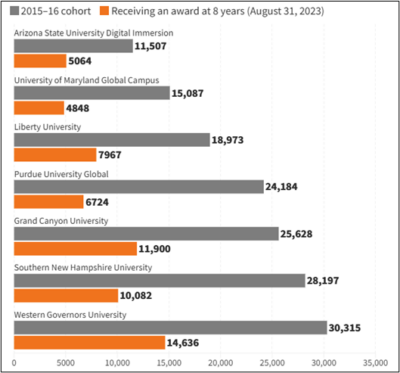
- Fueling Poor-Performing Schools. The Committees, student veterans, and taxpayers alike should heavily weigh the demonstrated outcomes of online programs and consider whether or not these programs are worthy of valuable GI Bill resources. Inside Higher Ed looked at the 8-year completion rate of the 2015-2016 cohort at large online institutions. The results of that analysis paint a stark picture, as evident in the chart that follows.
And even more specific to this population of students, a 2023 study published by the Annenberg Institute at Brown University found, “Exclusively online students with military service were 11.4 percentage points less likely to earn their bachelor’s degree compared to peers with military service not enrolled in exclusively online programs.”
- Marketing Tool for Bad Actors. Predatory schools would use the availability of an increased housing allowance as a selling point to target veterans to attend predatory and exploitative programs. In the aftermath of finally closing the 90/10 loophole, a shift to a full housing allowance for solely online colleges would re-establish veterans as targets for unscrupulous schools. Many of these schools have been sued by law enforcement and fined by federal agencies for defrauding students, and can reasonably be expected to abuse this change. ,
- Incentivizing Students to Leave Flagship Public Universities. Due to the higher housing allowance, such a policy change would incentivize veterans to leave high-quality, flagship public universities in low-housing-cost states – such as Kansas, Illinois, Wisconsin, and Texas – and enroll in national online college chains. Current housing allowance rates for in-person and hybrid learners are based on DOD housing allowance rates (BAH) for an “E-5 with dependents.” Over 60% of DOD’s 339 BAH zones have housing costs less than the national average, in some cases half of the national average. If Congress enacted the full housing allowance for online students, veterans attending high-quality public colleges would receive less housing assistance than those attending low-quality online colleges.
We urge the Committees not to move forward with any proposals increasing the MHA rate for online-only students. Instead, a near-term solution would be for Congress to direct an unbiased study of online learning outcomes regarding Title 38 veterans’ education benefits.
Summary of recommendations:
- Oppose full housing allowance for online-only students.
8. Protect GI Bill Payments from Recurring IT Failures
From the very beginning of the Post-9/11 GI Bill, VA experienced delays in GI Bill distribution and was forced to issue emergency payments of up to $3,000 to more than 25,000 veterans who were left without their funds. The following year, delayed payments persisted, and nearly 50,000 veterans continued to experience difficulties with VA’s failures. ,
More recently, while implementing the Forever GI Bill, VA experienced major IT failures in the fall of 2018. Housing payments for as many as 180,000 student veterans were delayed due to computer system updates and processing issues.
A separate—but all too familiar—breakdown occurred in 2023 when VA’s rollout of the digital enrollment system reportedly triggered an unexpected gap in housing payments. We testified that “VBA publicly announced a technical flaw that resulted in more than 280,000 student veterans’ being delayed on their monthly housing allowance (MHA) GI Bill payments. For nearly 4,000 of these veterans, VBA had to work with Treasury to mail hard-copy checks to the individuals to ensure continuity of on-time payments.” Congress should require VA to implement reliable technical safeguards, transparent timelines, and actionable contingency plans because delays should be anticipated.
Continuing the trend of IT failures and poor communication, VA once again left students scrambling this past fall with delays to Chapter 35 and other VA benefits. These benefits are fundamental to whether a student can remain enrolled, maintain housing stability, and cover the daily costs of attendance. When those funds disappear, the consequences are immediate and personal, as we saw throughout the semester.
One student veteran wrote to us to describe the difficult position she faced as a result of the delays:
I have not received one of my payments and it’s almost 90 days. I had my vehicle repossessed last week and I am facing eviction with late fees that are mounting[.] I am attending out of state school and I have no family near me. I am in dire need of assistance please help me. I can’t get any answers from the emails I sent and the phone calls that go unanswered. I checked the VA benefits website and it shows that my benefits are eligible, but they have not issued any payments. This goes back to August. This is affecting my life tremendously.
Dylan Virrueta-Torres, who served as a Boatswain’s Mate in the US Navy for five years and now attends Simpson University, shared:
Beginning of fall semester 2025 my pay for school was delayed for two months, during that time I tried to check in [to] the VA hotline (it was shutdown and in furlow) I got redirected each time and every person that answered the phone either has no access to my info, or didn’t know how to help, I called local congress representatives, I even went to navy federal for hardship loans and it was denied due to me not being a federal employee. Being in school put me in a weird circumstance where I relied on that money but don’t meet requirements for help; if it wasn’t for my loving fiancée and my job I would have been evicted and dropped out of school.
What made this situation more damaging was not simply the payment disruption, but the utter lack of communication. This is fundamentally a leadership failure, not merely a contractual error. VA was aware in August about the risk of payment delays. VA later described the payment failure as being the result of a technical malfunction of their IT rollout.
Once students became aware of missing payments, no one could get answers because the GI Bill hotline was classified as non-essential during the federal government shutdown—an issue we hope the Committee will address by requiring VA to deem the hotline an essential service. Yet, in the intervening months, no steps were taken to inform GI Bill students and stakeholders of the impending challenges.
Adding to this perspective, Joshua Rider, the Executive Director of the Center for Adult and Veteran Services at Kent State University, had this to share:
I have served in a leadership capacity in the area of military-connected student benefits for 16 years and have been a School Certifying Official [SCO] for 20 years. The recent debacle involving Chapter 35 benefits had the largest negative impact I have witnessed since the rollout of the Post-9/11 GI Bill in 2009-10 and the initial issues with paper checks. I would like to open by saying that this is an extremely vulnerable population, as they are the dependents and spouses of 100% Permanent/Totally disabled veterans.
Kent State is just one of 37 publicly funded institutions in the state of Ohio. In the Fall 2025 term, we certified 297 Chapter 35 students. Of that number 50% were affected by the technical and processing errors. This means that 148 students were without $1,536 per month until December. That’s $6,144 per student or $909,312 for the population. Those funds are used for both on and off-campus room and board. We worked with our students living in campus housing to ensure there were no issues with their food or housing. However, 40% of those affected students live off campus. For those 59 students, landlords and grocery stores are unwilling to assist with a $6,144 payment delay.
In summary, these are vulnerable students who were stripped of entitled funds upon which they and their families depend to fund their most basic needs: food, shelter, and heat. Kent State is just one example. If you multiply that number by 37, the regional impact is immense.
Recall that this was the third significant technology transition involving GI Bill payments in recent years that has caused considerable payment delays during implementation. Each was scheduled at the beginning of an academic term, when even minor interruptions can quickly lead to adverse outcomes for students. Modernizing systems is essential, but modernization that jeopardizes the delivery of core benefits is misguided. When the scheduling of VA’s actions guarantees maximum disruption if anything goes wrong, the planning has already fallen short.
The recurring theme of “technical glitches” (and the newer theme of “contract failures”) that inevitably leaves thousands of GI Bill students missing their education benefits is simply unacceptable. While VA always has an excuse for the error, the impact of these debacles falls on veterans and their families, who are forced to shoulder the burden of VA’s repeated failures.
There are practical steps VA should adopt to ensure this is avoided moving forward. Congress should direct VA to avoid releasing education benefit system upgrades during critical enrollment or disbursement windows and require independent certification of readiness before launch. A continuity plan is needed so that if one system fails or is offline, another is ready to take over. VA must adopt more rigorous testing of technology solutions and independent verification of efficacy. VA should also implement staged technology rollouts that prevent failures from reaching students in the first place.
Institutions should receive clear guidance to avoid penalizing students for late payments due to circumstances beyond their control. Most importantly, when VA becomes aware of a significant risk to on-time payments, it should proactively share that information with students, institutions, policymakers, and advocates before financial harm occurs. Education benefits delivery must be treated as an essential function that does not pause when other parts of government do.
Student veterans, survivors, and their families do not view their education benefits as optional. Oftentimes, they plan their lives around these benefits because that is what they were told they could count on. VA must build on the lessons learned from these failures to reestablish trust with GI Bill students.
Summary of recommendations:
- Implement reliable technical safeguards, transparent timelines, and actionable contingency plans for any failure to administer education benefits as otherwise anticipated.
- Adopt more rigorous testing of technology solutions and independent verification of efficacy; implement staged technology rollouts that prevent failures from reaching students in the first place.
- Provide proactive, plain-language notifications to students, schools, and oversight entities whenever payment risks are identified.
- Avoid releasing education benefit system upgrades during critical student enrollment or disbursement windows; instead, deploy upgrades during times of the year that are less likely to affect students negatively, and require independent certification of readiness before launch.
- Finally, strengthen oversight requirements, mandate transparent performance metrics, and ensure that students are not left bearing the cost of VA’s failures.
9. Change VA’s debt collection practices against student veterans
VA’s debt collection for “retroactive readjustments” of GI Bill benefits awarded to a veteran is of special concern, and we urge the Committees to halt this practice. A “retroactive readjustment” means that VA adjusts a veteran’s GI Bill eligibility after the veteran has already used his GI Bill. If the problem was a VA error and a veteran relied on VA’s procedures in good faith and was not engaging in malfeasance, then subjecting the veteran to debt collection is unfair.
One problem for veterans is that VA’s letters alerting veterans of a debt are often confusing and sent to outdated addresses. While Section 1019 of the Isakson-Roe Act has addressed some of the underlying factors associated with GI Bill overpayments, the issue of VA debt collection practices has not been comprehensively addressed.
We support the prohibition of VA from executing clawbacks based “solely on administrative error” or “error in judgment,” consistent with 38 U.S.C. § 5112(b)(10). However, it is our firm belief that VA defines administrative error quite narrowly based on the number of clawbacks that still occur. For instance, VA takes the position that if the beneficiary “should have known” they were not entitled to the benefit, then the overpayment was not due solely to administrative error. VA’s assessment of whether a beneficiary should have known they were not entitled to the benefit may disregard the realistic and practical limits of a student veteran’s understanding at the time of payment. It is also possible that the student’s misunderstanding stems from information originally provided by VA.
We urge Congress to ban VA’s authority to claw back overpayments when the overpayment is VA’s error and establish a limitation period after which clawbacks are prohibited, except for fraud or malfeasance.
Summary of recommendations:
- Halt the practice of VA’s “retroactive readjustments.”
- Improve debt notification processes to prevent veterans from being surprised by unclear or outdated notices.
- Establish a limitations period after which GI Bill clawbacks are prohibited, except for fraud or malfeasance.
10. Forbid transcript withholding
Student veterans lack the same protections against transcript withholding as other students in higher education. Transcript withholding is a frequent practice wherein colleges withhold students’ academic transcripts for outstanding balances, even when the debt is disputed, and can withhold transcripts even for minor charges like parking fees. It is one of the most common debt-collection tactics used by colleges across all sectors.
Hundreds of student veterans, service members, and their families have brought complaints to us about unfair transcript withholding and its negative impact on their lives. In March 2022, we published a report analyzing how transcript withholding affects the veteran and military communities. Of these student veteran complaints we received:
- 35% are related to disputed debts, often due to inaccurate billing or students believing their GI Bill or other educational benefits from VA or DoD covered the cost of attendance.
- 34% are general complaints about transcript withholding.
- 20% are related to debt arising from deceptive or predatory institutional practices.
- 7% are related to closed school issues.
- 4% are related to complaints over loans that the veterans did not authorize.
Transcript withholding has particularly severe consequences for student veterans. It can prevent them from transferring schools, re-enrolling, or pursuing an advanced degree if they have already graduated. It can also undermine a student’s eligibility for a job interview and even some military promotions.
While current ED regulations significantly limit transcript withholding, these rules are subject to change. We urge the Committees to enact Title 38 legislation to prohibit transcript withholding to collect outstanding debt from former students, irrespective of the periods covered by VA benefits, and we thank Representative John Mannion and James Moylan for championing this legislation.
Summary of recommendations:
- Pass H.R. 5436, To amend title 38, United States Code, to prohibit an educational institution from withholding a transcript from an individual who pursued a course or program of education at such institution using Post-9/11 educational assistance.
11. Strengthen Veteran Readiness & Employment
As outlined in our previous statements to Congress, we have continued to receive complaints from veterans about VR&E. , , Recent complaints continue to tell the story that the process for VR&E benefits is often too complicated and stressful. Veterans get tired of fighting for what they deserve. All too often, some counselors prove to be unresponsive or even antagonistic to a veteran’s interests.
Highlighted below are specific areas of concern raised by veterans who have contacted us, followed by recommendations for potential solutions to the challenges they face.
A. Veterans feel VR&E and its counselors steer them away from high-quality programs or push them to enroll in low-quality programs.
Many veterans have told us that VR&E counselors steer them away from top colleges and towards low-quality online programs. One recent veteran, a 100% disabled 12-year service member, was denied approval for an Ivy League business school. The counselor dismissed it as too expensive despite its clear career advantages and the likelihood of higher earnings. Veterans find the approval process arbitrary, as the same schools are approved for others.
B. Veterans complain that applying for and using VR&E benefits is too difficult; counselors have denied their admission to the VR&E program, denied their education program, or refused to cover certain programmatic costs without a reasonable explanation, causing tremendous stress.
One veteran was denied funding for essential coursework materials, including a laptop, with no apparent reason beyond a vague claim of insufficient funds. Others report difficulty using VR&E for graduate or professional degrees, with counselors blocking doctoral programs and instead approving degrees that do not align with their disabilities or vocational goals. Some counselors improperly decide that advanced degrees are unnecessary, even after veterans have already started their programs. Many veterans believe counselors lack training to assess how disabilities impact career options.
C. VR&E counselors are often challenging to reach and do not provide timely information and responses to veterans.
Veterans frequently report unresponsive, incompetent, or even antagonistic counselors who seem more focused on disqualifying them than helping. Some are repeatedly reassigned counselors, receiving conflicting guidance and decisions. Many worry about retaliation.
One veteran considered withdrawing from VR&E entirely after a year without a response from his counselor. A medically retired Army veteran struggled for over six months to even start the program.
Based on the issues addressed above, we make the following recommendations for the Committees’ consideration:
- Staff Ratio. Reduce the maximum client-to-counselor ratio from 125 to 85 to ensure veterans receive timely, individualized support. While VA has worked to reduce this number, 125 remains too high for counselors to address veterans’ needs adequately, and veterans continue to report unresponsive counselors.
- Counseling Consistency. Require increased training for VR&E counselors to ensure consistent, high-quality guidance. Too many veterans are steered into low-quality schools while others are approved for top-tier institutions. Counselors should be trained to avoid recommending schools with federal caution flags or law enforcement actions. They should be empowered to approve graduate degrees when needed to help veterans achieve their vocational goals. Additional training and explicit guidance would improve program delivery and the veteran experience.
- System Modernization. Continue to improve and modernize the VR&E case management system to prevent payment delays and reduce administrative burdens. Given the financial hardships many veterans face, timely payments are critical. We commend the e-VA Document Repository and Automation Initiative, which significantly reduces the burden on both veterans and counselors by streamlining required documentation.
- Housing Allowance Parity. Establish a Monthly Housing Allowance (MHA) for VR&E students at rates comparable to the Post-9/11 GI Bill to keep pace with rising living costs.
We thank the Committees for your attention to this critical issue and consideration of these recommendations. We will continue to provide feedback based on what we hear from the veterans with whom we work on an ongoing basis.
Summary of recommendations:
- Decrease the maximum client-to-counselor ratio from 125 to 85 to ensure veterans receive timely, individualized support.
- Mandate standardized, comprehensive training for VR&E counselors to ensure consistent, high-quality guidance, prevent arbitrary school denials, and adequately evaluate graduate and professional degree programs.
- Prohibit VR&E counselors from requiring veterans to attend low-quality online programs instead of high-quality, reputable colleges and from imposing sudden enrollment deadlines that force veterans into suboptimal education choices, and require reasonable accommodations for transcript access and administrative delays.
- Direct VA to modernize the case management system to prevent payment delays and reduce administrative burdens on veterans.
- Establish Monthly Housing Allowance parity between VR&E and Post-9/11 GI Bill students to reflect real cost-of-living needs.
12. Pass the Guard and Reserve GI Bill Parity Act so every day of service counts
We call on Congress to address a long-overdue issue affecting the eligibility of reserve component members for the Post-9/11 GI Bill® by passing the Guard and Reserve GI Bill Parity Act. The current law mandates that Guard and Reserve members must have served at least 90 cumulative or 30 continuous days on active duty to accrue “qualifying days,” creating a disadvantage in accessing their deserved GI Bill educational benefits. Despite the obligation for reserve component members to “serve in uniform” and fulfill duty responsibilities for a minimum of 39 non-consecutive days each fiscal year, these periods of service do not contribute toward Post-9/11 GI Bill eligibility.
This discrepancy disadvantages reserve component members compared to their active component counterparts. While active duty members can receive Post-9/11 GI Bill credit for a training day, reservists currently cannot receive credit for the same service. The increased reliance on reserve capabilities has underscored the necessity for component interoperability. Unfortunately, the strides made toward interoperability have not been matched by fair recognition and rewards for the skills and efforts required.
An Operational Assessment of Reserve Component Forces in Afghanistan, conducted by the Institute for Defense Analyses, revealed no discernible performance differences between components in Operations Iraqi Freedom and Enduring Freedom. The study emphasizes that reserve forces were fulfilling their assigned tasks without significant variations from their active-duty counterparts. The shared burden and risk between both components highlight the importance of acknowledging the contributions of Guard and Reserve members.
To address this disparity, we strongly urge Congress to count all paid points days of Reserve and National Guard service members towards receiving the Post-9/11 GI Bill. This encompasses days for training, active military service, inactive training, and general duty. This adjustment aims to ensure equitable treatment and recognizes the crucial contributions of reserve component members to military readiness. It is essential to promote fairness and acknowledge their vital role without compromising the integrity of the GI Bill system.
Summary of recommendations:
- Pass the Guard and Reserve GI Bill Parity Act so that a day in uniform truly counts as such.
Conclusion
Veterans Education Success sincerely appreciates the opportunity to express our legislative priorities before the Committees. The higher education industry continues to evolve in these dynamic times, and we emphasize the importance of maintaining high standards. Student veterans, taxpayers, and Congress must expect the best outcomes from the use of hard-earned GI Bill benefits.
We look forward to enacting these priorities and are grateful for the continued opportunities to collaborate on these initiatives.
Information Required by Rule XI, Clause 2(g)(4) of the House of Representatives
and the Rules of the House Committee on Veterans’ Affairs
Pursuant to Rule XI, clause 2(g)(4) of the House of Representatives, Veterans Education Success has not received any federal grants in Fiscal Year 2026, nor has it received any federal grants in the two previous Fiscal Years.
Information Required by the Rules of the House Committee on Veterans’ Affairs Regarding Foreign Government and Foreign Adversary Funding
Pursuant to the Rules of the House Committee on Veterans Affairs, and consistent with the definitions set forth in P.L. 118-50, Division H, § 2(g)(1), Veterans Education Success has not received any contracts, grants, or payments originating with a foreign government, a foreign adversary-controlled entity, or an entity or country of particular concern.
Annual Legislative Priorities 2026_Veterans Education Success